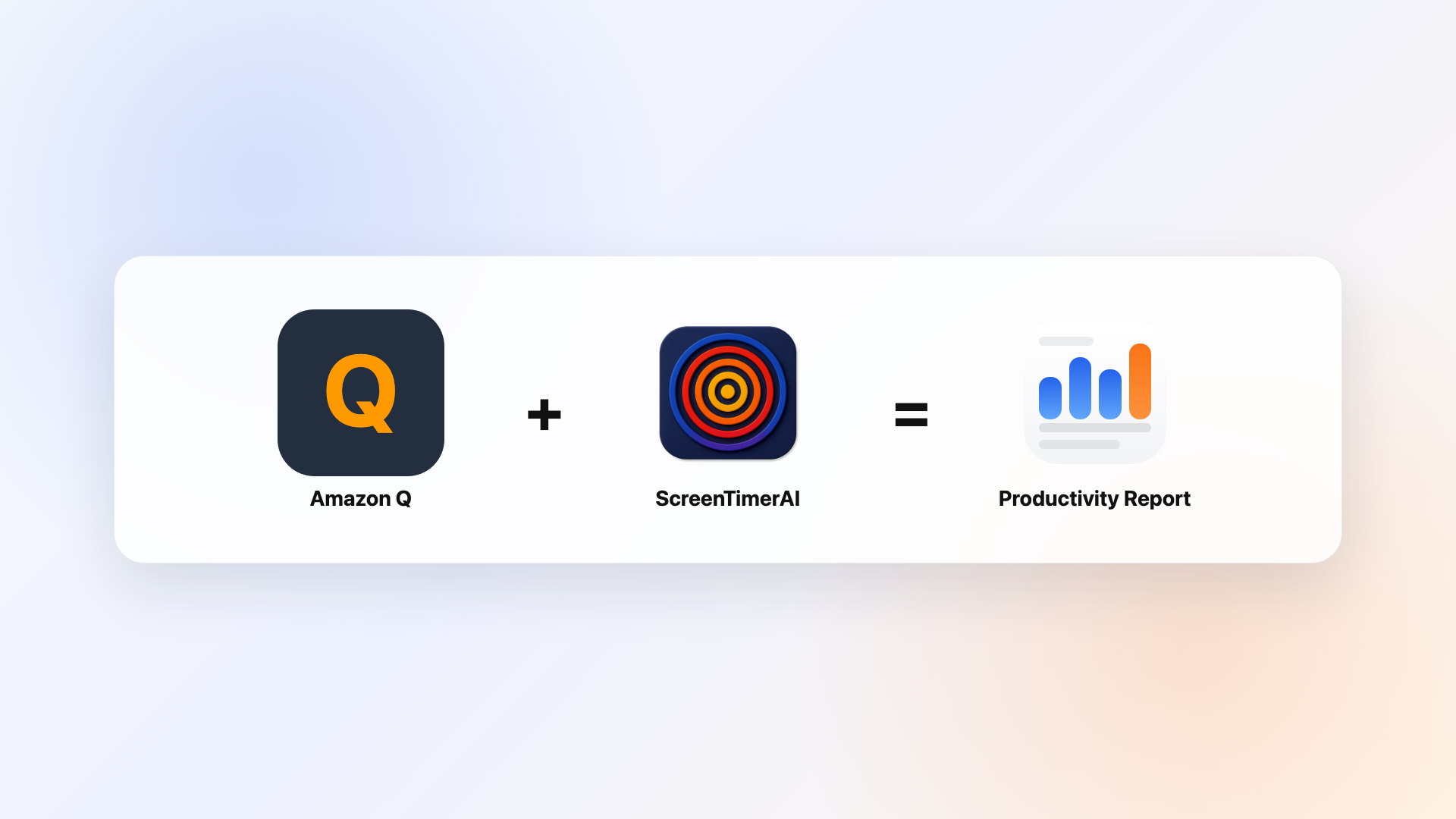
What You Are Making
An Amazon Q Developer prompt that reads yesterday's screen time data from ScreenTimerAI and generates a short daily productivity report.
Works in both the Q Developer CLI (q chat) and the IDE extension for VS Code and JetBrains.
Why Amazon Q Developer
Amazon Q Developer is AWS's AI coding assistant, available as a CLI agent (q chat) and as an IDE extension for VS Code and JetBrains. Developers working in AWS ecosystems use it daily, but it is also a strong choice for anyone who wants a capable AI agent in their terminal or IDE regardless of cloud provider.
Connecting screen time tracking to Q Developer makes sense because the agent already handles multi-step tasks and tool calling through MCP. Adding ScreenTimerAI data is just another tool in its toolkit. You can use the same chat interface you already use for coding questions to query your productivity data, analyze focus patterns, and generate reports — no extra app or dashboard required.
Step 1: Connect ScreenTimerAI To Amazon Q Developer
Create or edit the Amazon Q CLI config file:
~/.aws/amazonq/mcp.json
Add ScreenTimerAI as an MCP server:
{
  "mcpServers": {
    "screentimerai-activities": {
      "command": "/Applications/ScreenTimerAI.app/Contents/MacOS/activity-mcp-server",
      "args": []
    }
  }
}
If you want to test that Step 1 worked, start a chat session and try one of these prompts:
| MCP function | Test prompt |
|---|---|
get_current_activity | What am I doing right now? |
get_activity_logs | Get my raw activity logs for yesterday. |
show_activity_timeline | Show me an activity timeline for yesterday. |
summarize_activity_range | Summarize my activity for yesterday. |
analyze_focus_segments | Analyze my focus segments for yesterday afternoon. |
show_focus_score_timeline | Show me a focus score timeline for today. |
show_focus_score_trends | Show me my focus score last week. |
Step 2: Generate Your Daily Report
Start a chat session (q chat in the CLI, or open the Q Developer chat panel in your IDE) and paste this prompt:
Generate a daily productivity text report based on yesterday's Screen Time AI data.

Follow these steps:

1. Fetch yesterday's activity data from Screen Time AI.
2. Write a short productivity report (~150 words) from the perspective of a dark, witty productivity coach reacting to the data.

Rules:
- Focus more on failures than successes
- Use short, punchy sentences
- Be dark and witty, commanding not polished
- Swearing is allowed sparingly for impact
- Return only the final report text, nothing else

Return the report as plain text directly in the chat.
Amazon Q will discover the ScreenTimerAI tools and call them to fetch your data. The report appears in the chat.
Other Prompts To Try
Once the MCP connection is working, you are not limited to the daily report prompt above. Amazon Q can answer any question about your screen time data. Here are a few ideas to get you started:
- Top apps by time: "Show me my top 5 apps by time spent yesterday." Good for spotting which tools dominate your day and whether that matches your priorities.
- Context-switch count: "How many context switches did I have yesterday afternoon?" Frequent switches usually mean interruptions are eating into deep work.
- Week-over-week comparison: "Compare my screen time this week vs last week." Useful for tracking whether changes to your routine are actually moving the needle.
- Productive-hours analysis: "Analyze my focus segments for yesterday and identify my most productive hours." Helps you schedule demanding tasks during your natural peak focus windows.
Mix and match these with the MCP functions in the table above to build your own reporting workflow.
Troubleshooting
- Tools not discovered? Make sure the config file is in the right location. For the CLI it should be
~/.aws/amazonq/mcp.json. For the IDE extension it should be~/.aws/amazonq/default.json. A misplaced file is the most common setup issue. - Permission errors on tool calls? Type
/tools trustin the CLI chat to allow tools to run without per-call confirmation. In the IDE, you can set per-tool permissions in the Q Developer panel under the Tools section. - Server not connecting? Verify the binary path
/Applications/ScreenTimerAI.app/Contents/MacOS/activity-mcp-serverexists and is executable. You can check by runningls -lon that path in your terminal.
What Happens Next
Every time you run the prompt, Amazon Q pulls your latest screen time data through the MCP connection and generates a fresh report.
Use it as a quick daily check-in from your terminal or IDE.